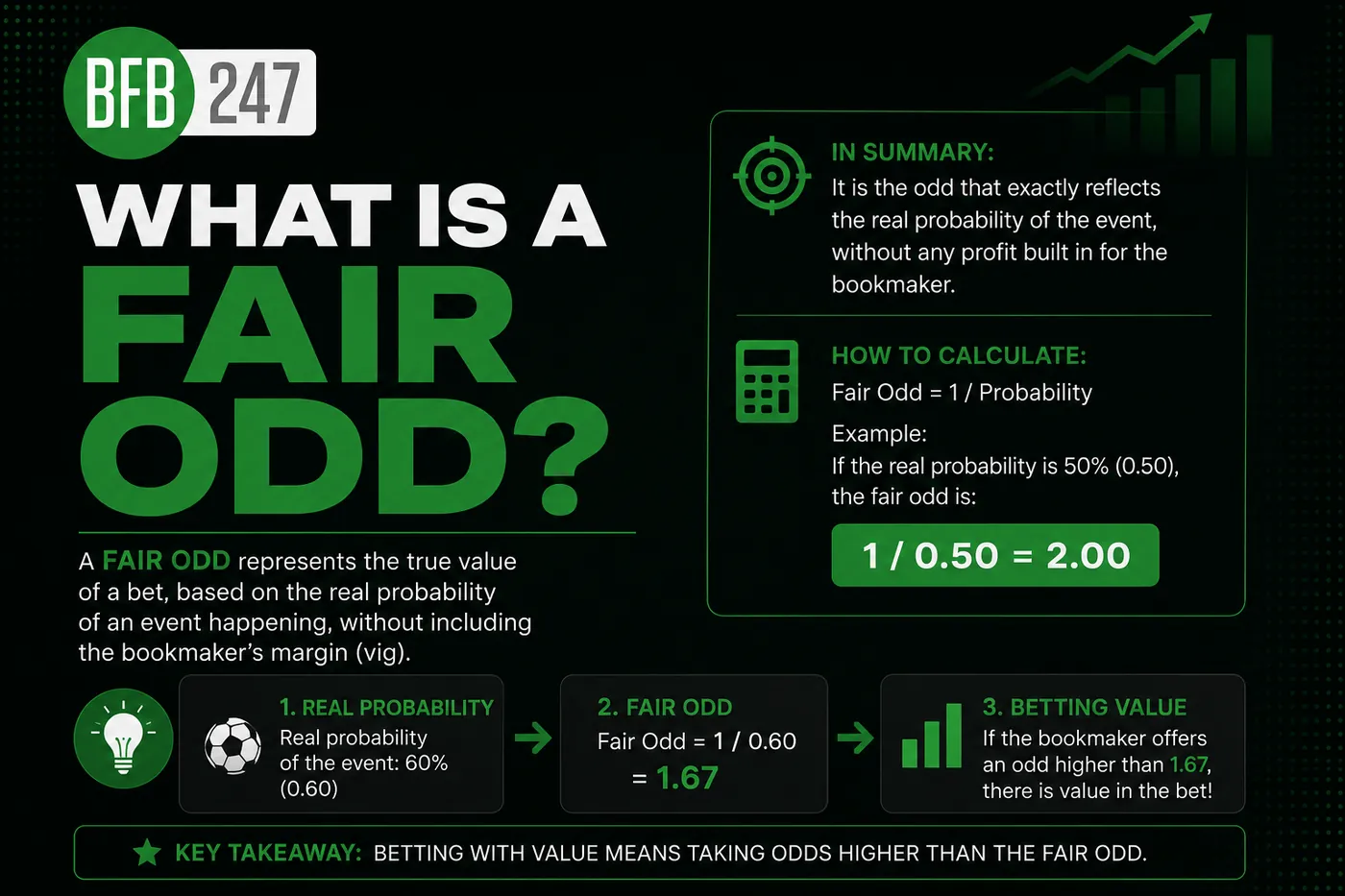
What is a Fair Odd?
A fair odd is the odd that exactly reflects the true probability of an event occurring, without any bookmaker margin. It is, in essence, the true price of a bet.
When betting at a traditional bookmaker, the displayed odds already include a margin — called the overround or vig — that guarantees the house's profit regardless of the outcome. The fair odd would be the value that would exist if that margin were zero.
How to Calculate the Fair Odd
The calculation is simple and straightforward:
Fair Odd = 1 ÷ True Probability
Practical example:
- True win probability: 50% (0.50) → Fair Odd = 1 ÷ 0.50 = 2.00
- True win probability: 60% (0.60) → Fair Odd = 1 ÷ 0.60 = 1.67
If the market odds are higher than the fair odd, you have a value bet — a bet with a mathematical edge in your favour.
Why Fair Odds Matter on Exchanges
On betting exchanges like Orbit Exchange, you bet against other users — not against the house. This means:
- Odds are set by the market, much closer to fair odds
- Commission is applied only on profits (typically 3–5%), not on the stake
- You can access odds that may be equal to or above the fair odd
- You can lay (bet against an outcome), opening strategies unavailable at traditional bookmakers
Fair Odds and Expected Value (EV)
The fair odd is directly linked to Expected Value (EV) — the core mathematical concept for any professional bettor.
- Positive EV (+EV): market odd is above the fair odd → value bet
- Negative EV (−EV): market odd is below the fair odd → no long-term value
Professional bettors systematically seek +EV bets. Over time, betting only in +EV situations guarantees long-term profit regardless of individual results.
Start Betting with Fair Odds
Register on Orbit Exchange via BFB247-96EX and access odds closest to true value — with commissions from 3%.
Open Free Account →Article published by the BetAdvisor ST Team. June 2026.